The Volunteer Role That Quietly Became Three Jobs
Volunteer role creep starts with vague duties. Learn to name one bounded task and a clear handover point before a helpful offer becomes three jobs.
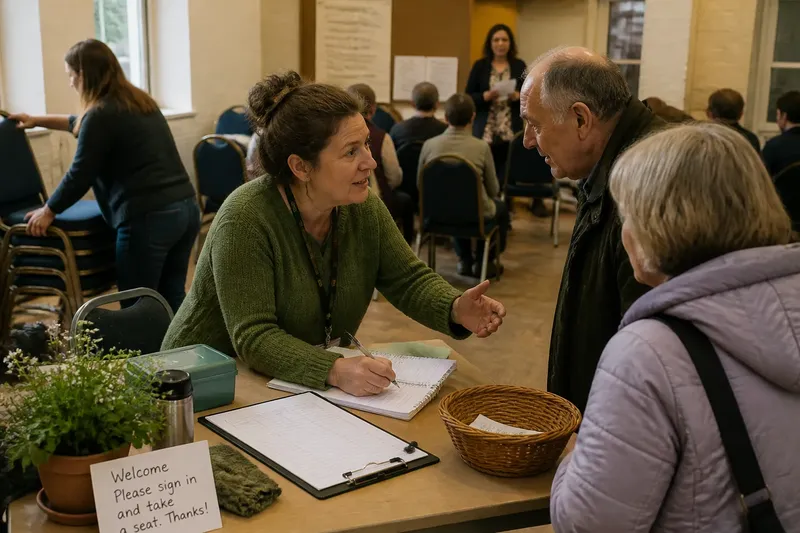
You agree to put out chairs for the residents’ meeting, then find yourself welcoming late arrivals, taking notes and locking the hall. That small shift is volunteer role creep: a useful offer quietly expanding into work nobody clearly assigned. Naming a bounded task and a handover point can keep a willing contribution manageable.
How roles expand
At first, the extra requests can sound like ordinary cooperation. Someone asks you to keep an eye on the sign-in sheet while they fetch a key; later, people assume you will bring the sheet next time, answer questions and follow up with anyone who missed the meeting.
The problem is rarely one unreasonable request. It is the gap between what a person offered and what others now expect. If nobody says where the task ends, every unfinished piece of nearby work can appear to belong to the same volunteer.
Unspoken expectations also hide in labels such as “help with the event” or “keep things running”. One person may hear “set up the tea table”; another may picture organising supplies, managing clean-up and handling the venue afterwards. A friendly phrase can conceal several separate jobs.
Bounded tasks
A bounded task has a clear action, a limit and an endpoint. “Put out the chairs before the doors open” is easier to understand than “help set up”. The limit could be a particular area, one session or a named part of an event; the endpoint might be when the chairs are in place or when another volunteer takes over.
Specificity is not cold or fussy. It helps a volunteer decide what they can offer, and lets the coordinator notice when a new need requires a new conversation rather than silently attaching itself to an existing role.
Try phrasing an offer in one sentence: “I can set up the welcome table before the meeting, but I can’t stay to manage it.” That gives the group something useful while making the boundary visible. A coordinator can then ask someone else to cover the welcome desk during the meeting.
Handover points
A task needs a handover point as well as a boundary. This is the moment when responsibility passes to a named person or returns to the group. Without it, a volunteer may feel obliged to keep going because no one has formally taken over.
For a neighbourhood litter pick, a handover might be the moment filled bags are placed at the agreed collection spot and the coordinator confirms who will arrange disposal. The person who gathered litter does not automatically become responsible for transport, storage or future clean-ups.
Say you offer to welcome people at a community supper. You agree to greet arrivals until another volunteer takes the door, then hand them the sign-in sheet and mention that one guest asked about step-free access. The observable result is a clear transfer of the welcome desk and useful information, rather than an assumption that you will stay and solve every question.
Agreeing the edges
Before accepting a role, ask what the task includes, when it ends and who takes over. If the answer is still vague, suggest a smaller version you can commit to. “I can water the planters on Saturday morning, but I can’t monitor them through the week” is more useful than a hesitant yes that nobody knows how to interpret.
It can also help to name what is outside the role. A volunteer sorting donated books might be responsible for grouping them on the table, but not for deciding which donations the group should keep or arranging collections. Those decisions need an owner of their own.
When a new request appears, pause before absorbing it. Ask whether it is a one-off favour, a new task for this event or an ongoing responsibility. If it is ongoing, the group can discuss who has capacity and what existing work should change.
Useful boundaries?
What if nobody else can take over?
Say clearly what you can finish and when you need to stop. The group can then decide whether to recruit another helper, reduce the activity or leave a non-essential task undone.
Can one person hold several tasks?
Yes, if each task is agreed separately and the volunteer wants to take them on. Keep the endpoints distinct so completing one job does not silently sign that person up for the next.
What if the role changes during an event?
Ask for a quick agreement on the new task, its limit and who will take it afterwards. A brief conversation is clearer than letting an emergency request become a permanent expectation.
Is a written role description necessary?
For a small, one-off job, a message or spoken agreement may be enough. Write it down when several people share the work, the task recurs or confusion would leave an important responsibility unattended.
Make stopping normal
Groups can make boundaries easier by asking volunteers to name what they can do and by thanking them at the agreed endpoint. A simple rota, a note on a clipboard or a message in the group chat can record who has the next handover, without turning a neighbourhood project into paperwork.
It is not worth tracking every tiny favour or drafting a formal description for putting out a few chairs. Keep the process proportionate: clarify the edges where responsibilities could spread, decisions need an owner or someone might otherwise feel unable to leave.
Volunteer role creep is easier to prevent when a helpful offer remains an offer, not an open-ended promise. Name the task, state its boundary and agree who receives it next; that small piece of clarity leaves room for people to keep contributing without inheriting work they never chose.