Why a Skill Swap Needs More Than a List of Offers
A skill swap works better when people can name what they want to learn and what an offer includes, making it easier to choose a useful first exchange.
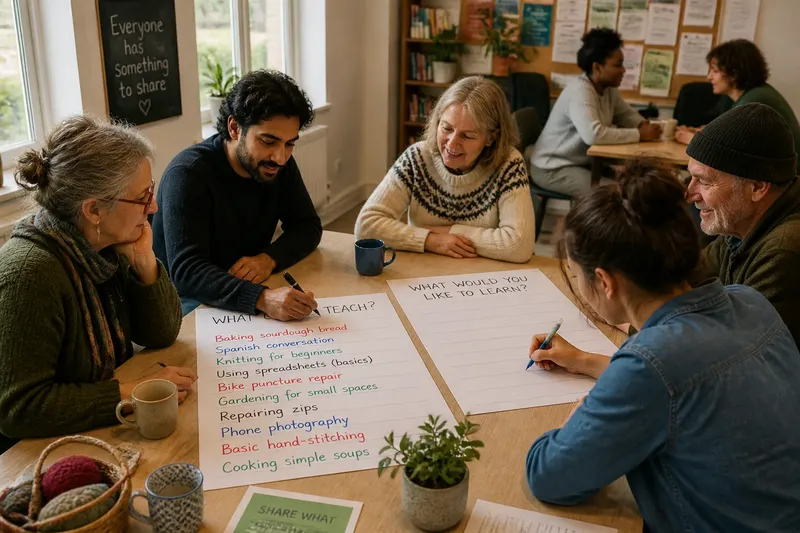
At a community-centre table, a sheet headed “What can you teach?” fills quickly: baking, languages, knitting, spreadsheets. The matching sheet is still blank. A useful skill swap starts not with a bigger inventory but with clear learning requests and offers narrow enough for someone to choose.
If you are organising one, think of each exchange as a small, understandable invitation. Someone should be able to see what they might learn, what the other person is offering, and what to do next without needing to decode a broad list of talents.
Why lists stall
A talent is not yet an exchange. “Good at gardening” might mean anything from identifying houseplants to planning a vegetable bed, while “wants to learn gardening” gives the other person little to respond to.
Broad labels can also make people feel they need to arrive as experts. Someone who can mend a dropped hem but cannot teach dressmaking may skip the sign-up because “sewing” sounds too ambitious. A specific offer shows that everyday knowledge has a place.
Requests help organisers see the other half of the picture. A resident who writes “show me how to repot a root-bound spider plant” gives a potential partner a clear starting point. The request does not need to be polished; it needs to say what the learner hopes to do.
What makes a request specific?
A good learning request names an activity, a starting point, and a useful outcome. “Help with cooking” is difficult to match. “Show me how to make a simple soup from vegetables I already have” gives an offer-holder something concrete to accept, adapt or clarify.
Ask people to finish a prompt such as, “I’d like to learn how to…” or “I can already…, and I’d like help with…”. That second version makes room for partial knowledge: a learner may know how to use a phone camera but want to practise taking a sharper picture indoors.
Requests can also name a constraint that matters to the exchange. A person might prefer a conversation rather than a written guide, or need a task they can try with materials already at home. Invite such details without asking for private information that is not needed to make a match.
How bounded should an offer be?
Describe an offer by its first useful outcome, not by the full reach of the subject. “I can show you how to thread a sewing machine and sew a straight seam” is easier to join than “I teach sewing”. It sets an approachable boundary and gives both people a natural stopping point.
A bounded offer can say what is included, what is not, and what the learner needs to bring. For example, someone offering basic spreadsheet help might cover sorting a list and using a simple sum, but not promise to build a complete business system. This is not a disclaimer; it is a way to make the invitation honest and comfortable.
Keep the wording in ordinary language. “Practise taking a clear head-and-shoulders photo using your phone” tells a newcomer more than “mobile portrait photography”. Plain descriptions help people recognise an offer they would otherwise assume was meant for someone more experienced.
How do you match requests and offers?
Match the requested outcome to the offered activity, then check whether the scope and format fit. Similar words are not enough: a request to learn conversational Italian may not match an offer to explain Italian grammar, though the two could still meet if both people agree on a useful first session.
When the match is close but not exact, ask each person before pairing them. A short message such as, “Would practising a few travel phrases suit your offer?” gives the offer-holder a chance to narrow or decline without awkwardness. It also lets the learner decide whether that is what they meant.
Say you are coordinating a swap where one neighbour asks to learn how to patch a small tear in a coat and another offers basic hand-stitching. You could confirm that the learner wants a visible patch rather than an invisible repair, and that the offer-holder is comfortable teaching that method. The expected result is a match with a shared, practical aim, rather than two people discovering their expectations differ after they meet.
Not every request needs a match. Keep unmatched requests visible, with permission, so someone with the right offer can come forward later. Do not stretch a person’s offer merely to make the list look complete.
What should a sign-up form ask?
Make the form quick to scan and easy to answer. Separate “I can offer” from “I’d like to learn”, and give a short example under each. A few useful prompts are better than a long questionnaire that makes participation feel like an application.
- Offer: What can you show someone doing?
- Offer boundary: What would a first useful session cover?
- Request: What would you like to be able to do?
- Starting point: What have you already tried, if anything?
- Format: Would you prefer to meet, talk by phone or exchange written notes?
- Materials: Is there anything you can provide, or would the learner need to bring something?
- Contact preference: How may the organiser introduce you to a potential match?
Let people submit more than one request or offer if they wish, but ask them to write each as a separate item. That makes it possible to match “basic bike puncture repair” with one person and “beginner knitting” with another, instead of treating one long description as an indivisible package.
It is not worth asking everyone to rank a long list of skills they might teach, or to write a miniature biography. Those details create work without necessarily clarifying what the person wants to exchange. Collect only what helps someone say yes, suggest a useful adjustment, or pass.
How can a first exchange feel fair?
Make the purpose of the swap clear without implying that every session must be repaid in equal time or effort. People may have different schedules, confidence levels and ways of sharing knowledge. Ask participants what feels comfortable, then agree on the shape of the exchange between them.
It may be a single demonstration, a practice session followed by a check-in, or a conversation in which each person shares a different skill. An organiser can offer these as possibilities, but should not assume that one format suits every match. A clear description lets participants choose without turning the exchange into a transaction ledger.
Before introducing people, explain what contact details will be shared and ask permission. Once connected, they can agree on a suitable public or private setting, timing and any materials. If the topic involves specialist or safety-sensitive work, keep the offer within the person’s competence and suggest appropriate professional instruction where needed.
What if nobody matches?
An unmatched request is useful information, not a failed event. It may point to an offer the community has not yet surfaced, or show that the request needs a narrower outcome. Ask the learner whether they would like to keep it open, adjust the wording or leave it for now.
Likewise, an offer with no current learner can remain available without being pressed into an unsuitable pairing. If several people ask for the same thing, the organiser might invite the offer-holder to propose a small shared session, provided they are happy to do so. A group activity should be an option, not a way to override what people initially requested.
Questions organisers often ask?
Should people offer only skills they can teach professionally?
No. A skill swap can include everyday knowledge, as long as the offer is described honestly and stays within the person’s ability. Someone can offer a beginner-friendly introduction without presenting themselves as a qualified instructor.
What if someone does not know exactly what to ask for?
Invite them to describe a task that currently feels difficult, or something they would like to do without help. An organiser can help turn that into a smaller request, such as “learn to organise photos into phone albums” rather than “get better with technology”.
Can one offer meet several learning requests?
Yes, if the offer-holder wants to share the skill with more than one person and the session still suits their boundaries. Check that participants want the same kind of outcome before grouping them, rather than assuming that a shared topic means shared expectations.
Should every exchange include a return lesson?
No. Some participants may want to teach, some to learn, and some to do both at different times. Make any expectations about reciprocity explicit when people sign up, then let each match agree on an arrangement that feels fair to them.
Keep the invitation clear
A skill swap becomes easier to join when each person can recognise a request they might answer or an offer they would feel comfortable accepting. Keep the words concrete, the boundaries visible and the introduction optional; that is enough to turn a catalogue of talents into a set of real possibilities.
When you revise the sign-up sheet, read each offer beside a likely learner’s request. If you can picture what the two people would actually do together, the wording is doing its job. That small check can make a skill swap feel welcoming before anyone has even met.