Turn Neighbourhood Oral History into a Memory Map
Neighbourhood oral history becomes easier to share on a memory map that links each story to a place, preserves its context and distinguishes recollection from fact.
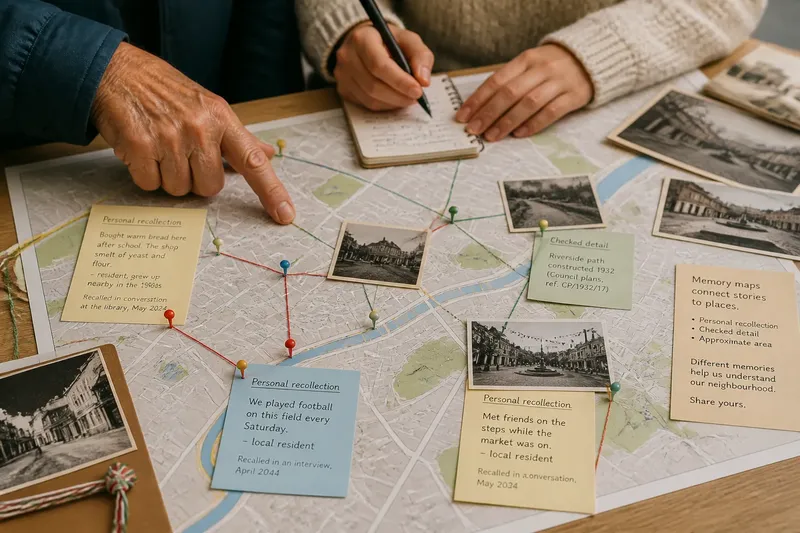
A neighbour points to the corner shop on an old street and remembers buying warm bread there after school. A neighbourhood oral history memory map can hold that detail beside the place it belongs to, while making clear what someone recalls and what a source can confirm.
The aim is not to settle every disagreement or create a definitive record. It is to connect memories to locations, keep their context attached and give residents a useful way to explore them.
Choose a focus
Set a manageable question before collecting stories. You might focus on how people used the high street, where residents gathered outdoors or how a particular route changed in daily life. A defined subject helps contributors know what to share and gives the finished map a shape.
Decide who the map is for, too. A display in a community centre can invite browsing and conversation; a map for a local history group may need fuller notes and a way to revisit sources. Keep the purpose specific enough that readers can see why each memory belongs.
Mark meaningful places
Start with locations people can recognise: a bus stop, a former playing field, a riverside path, a community hall or a building that has changed use. A marker should point somewhere a reader can identify without relying on exact coordinates.
Some memories do not belong to one precise spot. A story about walking to school may follow a route, while a recollection of a busy market might cover a whole street. Use a line or shaded area where that is clearer than a pin, and explain the choice in a short note.
Keep the speaker visible
Without its speaker, a memory can sound more certain than it is. With permission, include the contributor’s chosen name or a description such as “a resident who lived nearby as a child”. Let people remain unnamed if they prefer, and leave out personal details that do not help readers understand the recollection.
Record when and how the memory was shared, if the contributor agrees. A note such as “recalled in a conversation at the library” gives context without turning the map into a transcript archive. Ask whether the words may be shortened or lightly edited, and show the edited version back to the speaker where practical.
Distinguish memory from fact
Use plain labels readers can understand at a glance. “Personal recollection” signals that a marker records someone’s account; “checked detail” can identify a claim supported by an accessible source. A memory can be valuable even when no document survives, and a confirmed date does not make one person’s experience universal.
Keep those layers distinct in the wording and design. If someone recalls that a cinema stood on a particular corner, attribute the recollection to them. If a directory or local archive confirms the building’s use, attach that source to a separate factual note rather than silently rewriting the memory as established fact.
Invite stories carefully
Invite people to tell stories in their own way rather than pressing them for a polished timeline. Gentle prompts can help: “What do you remember noticing here?” or “Was there a route you often took?” Make clear that contributors can skip a question, pause or ask for a detail to be left out.
A public place does not make every story suitable for public display. A recollection may involve a private home, a painful event or another person’s sensitive information. Ask before recording or sharing it, and agree whether the contributor wants a name, an anonymous attribution or no map entry.
Match markers to sources
For each entry, keep a compact working record: the location as described, the speaker’s wording, when it was shared, permission for use and any source used to check a factual claim. This helps volunteers maintain the map without treating every sentence as equally verified.
Possible sources include a dated photograph, a council map, a local archive catalogue or a newspaper held by a library. Name the source and what it supports. A photograph of a building may confirm its appearance, for instance, but not a memory of what happened inside it; if a source cannot be checked, say so.
Leave room for disagreement
Residents may remember the same place differently. One person might describe a yard as a play area, while another recalls it as somewhere to avoid. That contrast can show how people experienced a location, so do not force the accounts into one shared version.
Say you are mapping memories of a former market square. One contributor recalls meeting neighbours beside the fountain; another remembers stalls occupying that spot and meeting friends at nearby steps. Keep both markers, attribute each account and add a checked note about the square’s layout only if a source supports it.
Make the map readable
A paper map can work well on a noticeboard when markers use clear symbols and each has a matching story card. A digital map may make it easier to search by place or theme, but it also needs a readable route for people who do not use the platform. In either format, include a short key explaining memory labels, source notes and approximate areas.
Keep marker text concise and put longer context in an accompanying card or linked page. Check that print is readable and that the digital version can be used with a keyboard or screen reader where possible. The map should help people find a story, not make them decode the design first.
Plan for updates
A shared map needs a simple way to correct a location, withdraw a contribution or add a source later. Name a contact point and decide who can make edits; otherwise, a request may disappear among messages or leave a disputed entry untouched.
Agree a light review routine with the people maintaining the project. Check that links still work, permission notes are retained and labels remain clear as stories are added. Decorative pins are not worth polishing while basic attribution or a contributor’s removal request remains unresolved.
Questions about memory maps?
Can a memory go on the map without a document?
Yes, if it is presented as a personal recollection rather than a verified fact. Keep the speaker’s attribution and any limits they placed on sharing alongside the story.
How should conflicting accounts appear?
Keep each account separate and identify who recalls it, without implying that one must cancel the other. Add a factual note only when a source supports that particular claim.
What if someone asks to remove a story?
Provide a clear contact route and explain who can act on the map. Respond respectfully and remove or revise the entry in line with the permission agreed with the contributor.
Can the map include sensitive places?
Only include details contributors have agreed to share and that do not expose someone to unwanted attention. A general area or an omitted marker may be more appropriate than pinpointing a private address.
Keep place and voice together
A neighbourhood oral history memory map is strongest when a location leads readers to a person’s account, not to an unsupported claim about what everyone remembers. Keep attribution visible, let sources speak only to what they confirm and leave room for stories that differ.
Before sharing an entry, read its marker aloud beside the map: can a neighbour tell where it belongs, who remembers it and what has been checked? That small pause can catch muddled wording. Keep the agreed contact route beside the map, too, so a contributor knows where to ask for a correction or removal.